
The Center for Local and Regional Governance (CLRG) Policy Briefs are annual concise, evidence-informed publications that translate research findings, policy analyses, and practical experiences into accessible insights and actionable recommendations to inform public policy and improve local and regional governance and public service delivery.
Submissions may be based on completed or ongoing research projects, policy reviews, case studies, program evaluations, or other relevant analyses and practical experiences.
Editorial board
Editor | Reginald G. Ugaddan, Ph.D. | |
|---|---|---|
Managing Editor | Reinalyn M. Velasquez | |
Editorial Staff | Sheryll Mae P. Pascobillo | |
Florabelle G. Tanguilig | ||
John Vincent C. Bucal |
Submission Guidelines
Editorial and Review Policies
All submissions undergo an initial desk review by the CLRG editorial team to assess their relevance, quality, originality, and compliance with the submission guidelines. Manuscripts that pass the initial screening will undergo a double-anonymized peer review process.
Following the review process, the editorial team may accept the manuscript, request revisions, or decline it for publication.
Authors must observe the following:
- Originality: Submitted manuscripts must be original and must not be under consideration for publication elsewhere. Any substantial overlap with previously published work must be disclosed.
- Copyright and Permissions: Authors are responsible for securing the necessary permissions for all copyrighted materials included in their submissions, including text, figures, photographs, tables, and datasets.
- Authorship: All individuals listed as authors must have made substantial contributions to the manuscript and must have approved its final version.
- Conflict of Interest: Authors must disclose any financial, institutional, or personal relationships that may influence the content or interpretation of their work.
- Accuracy and Accountability: Authors are responsible for the accuracy, integrity, and proper attribution of all information, data, and references presented in their manuscripts.
The views and opinions expressed in published policy briefs are solely those of the authors and do not necessarily reflect the official views or positions of the CLRG or the University of the Philippines.
All accepted policy briefs will be published online. The corresponding volume and issue numbers will be assigned upon publication.
Manuscript Requirements
General Requirements
- Manuscripts must be submitted in MS Word (.doc or .docx) format.
- Use clear, concise, and professional language. Avoid unnecessary jargon and define technical terms when first introduced.
- Spell out acronyms upon first use, followed by the abbreviation in parentheses. Use abbreviations consistently thereafter.
- Ensure that all hyperlinks are active and working.
Formatting
- Font: 12-point Times New Roman.
- Line Spacing: Double-spaced throughout the manuscript.
- Margins: 1-inch margins on all sides.
- Alignment: Left-aligned.
- Paragraphs: Indent the first line of each paragraph.
- Headings: Use bold formatting and proper capitalization. Maintain consistent heading levels throughout the document.
- Page Numbers: Place page numbers at the bottom center or bottom right of each page.
Tables, Figures, and Equations
- Tables must be created and formatted directly in MS Word rather than inserted as images. Place them near their first mention in the text.
- Graphs, charts, maps, photographs, and illustrations must be of high resolution (at least 300 dpi) and submitted in .jpg or .png format. Figures should also be embedded in the manuscript near their first mention.
- Equations must be created using the Microsoft Word Equation Editor. Avoid inserting equations as images or screenshots. Lengthy or complex equations should be displayed on a separate line.
- All tables and figures must have descriptive titles, appropriate labels, and sequential numbering. Include source notes and relevant explanations where necessary.
Structure and Content
Title | A clear, concise, and informative title that reflects the focus of the policy review. The title should be sticky and engaging, grabbing the reader’s attention and conveying a core message rather than relying on an overly academic or technical title. |
|---|---|
Executive Summary | A succinct overview of the paper (200-300 words), highlighting the policy problem or issue being addressed, the most significant findings or insights, and the main policy recommendations. |
Main Body |
Pointers for Practitioners and Policymakers:
Present 3–5 key takeaways highlighting the most important findings, practical implications, and recommended actions for policymakers, local government officials, and governance practitioners. Present these in bullet points.
|
Policy Context:
Introduce the policy issue and establish its significance. This section should (a) describe the policy problem and its relevance to local and regional governance, (b) present relevant historical, institutional, and legal context, (c) discuss existing policies, programs, or institutional arrangements, and (d) identify gaps, limitations, or implementation challenges that necessitate policy attention.
| |
Key Findings:
Present the major findings and insights from the research, policy review, or analysis, supported by relevant data, evidence, and references. Explain their implications for existing policies, institutional arrangements, and governance practices.
| |
Policy Recommendations:
Present specific, actionable, and evidence-based recommendations that address the identified policy problem. Where applicable, identify the institutions or stakeholders responsible for implementation and consider the resources, requirements, and potential challenges involved.
| |
Conclusion:
Reinforce the central policy message and summarize the significance of the proposed recommendations.
| |
Acknowledgment:
Authors should acknowledge the institution, organization, or funding body that supported the research or development of the Policy Brief, where applicable.
If the policy brief is derived from an existing study, technical report, or commissioned project, authors should identify the original work, its commissioning or implementing institution, and provide its full bibliographic reference and a working hyperlink, if publicly available. | |
References:
List all sources cited in the manuscript using the APA 7th edition referencing style.
| |
Appendices (if applicable):
Include supplementary materials that support the discussion but are not essential to the main text, such as detailed tables, research instruments, additional data, or case examples.
Label each appendix clearly. | |
Basis of Analysis and Link to Research:
This section transparently states the foundation of the brief’s analysis. The content will vary depending on the status of the research:
◦ If based on a completed study, provide a precise reference and a hyperlink to the complete, in-depth policy study or research paper. ◦ If based on ongoing research, mention the title of the research project and its expected completion date. |
Citations and Referencing
Use the American Psychological Association (APA) 7th edition style for all in-text citations and reference entries. Ensure that all cited sources appear in the reference list and that all reference entries are cited in the manuscript. Arrange the reference list alphabetically by the first author’s surname, double-spaced, and with hanging indents.
Footnotes should be used sparingly, indicated by superscript numbers in the text, and placed at the bottom of the corresponding page.
Submission Procedure
Submit completed manuscripts via email to clrgpolicybrief.upd@up.edu.ph. Use the following subject line format: PB Submission: <Title of the Policy Brief>.
Authors should ensure that their submissions comply with the requirements outlined in these guidelines before submission. The editorial team will acknowledge receipt and communicate the results of the initial screening and subsequent review process.
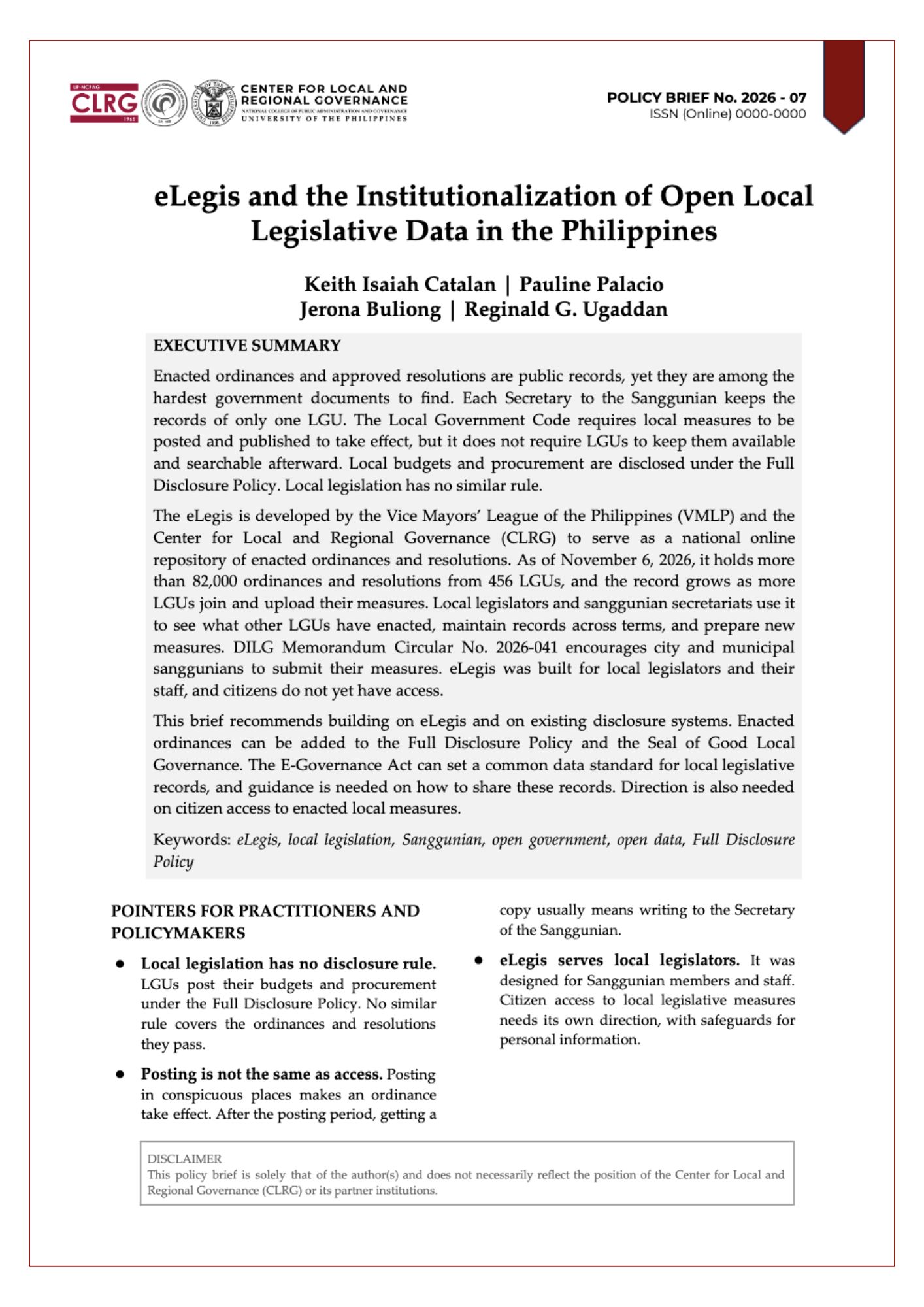
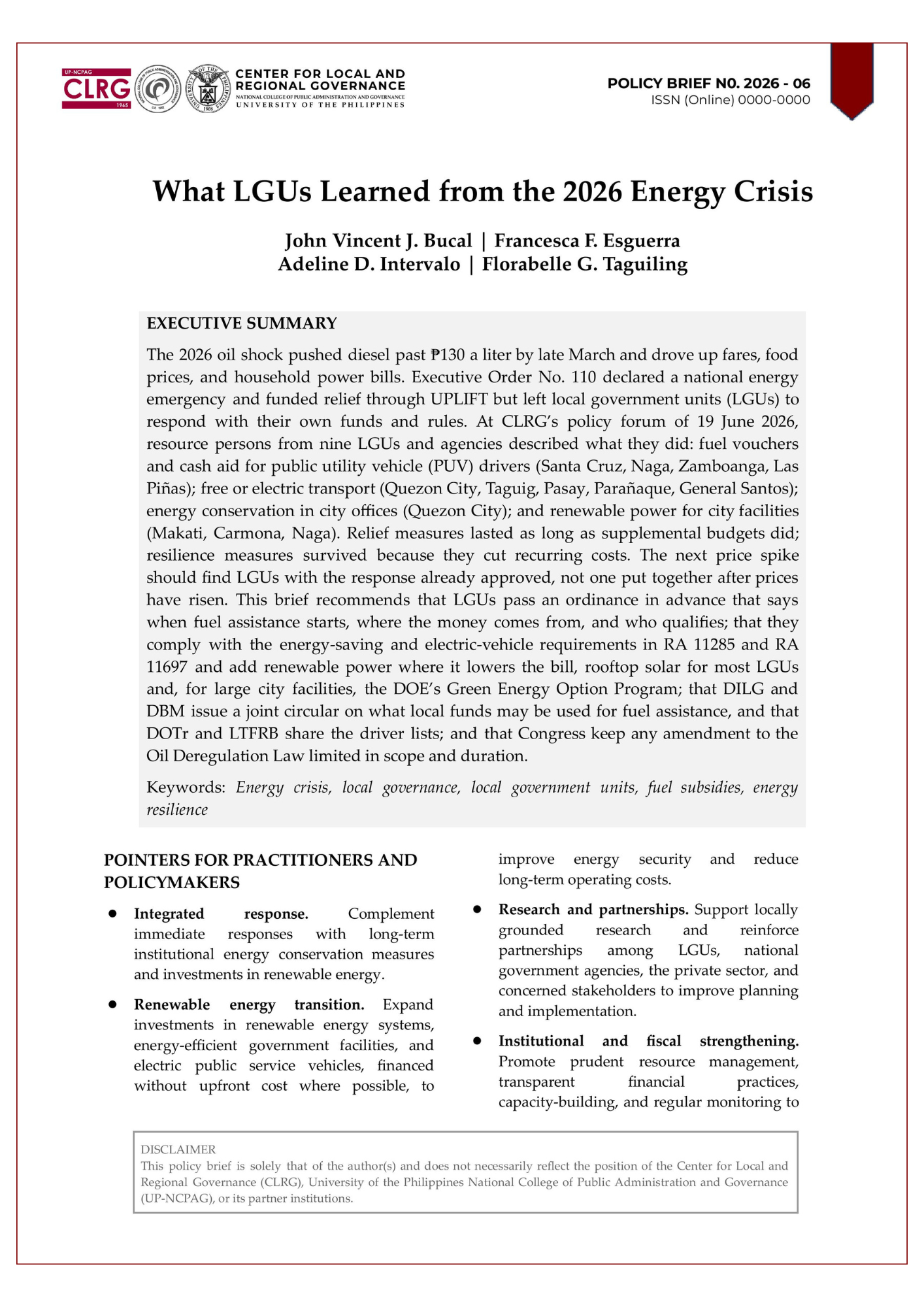
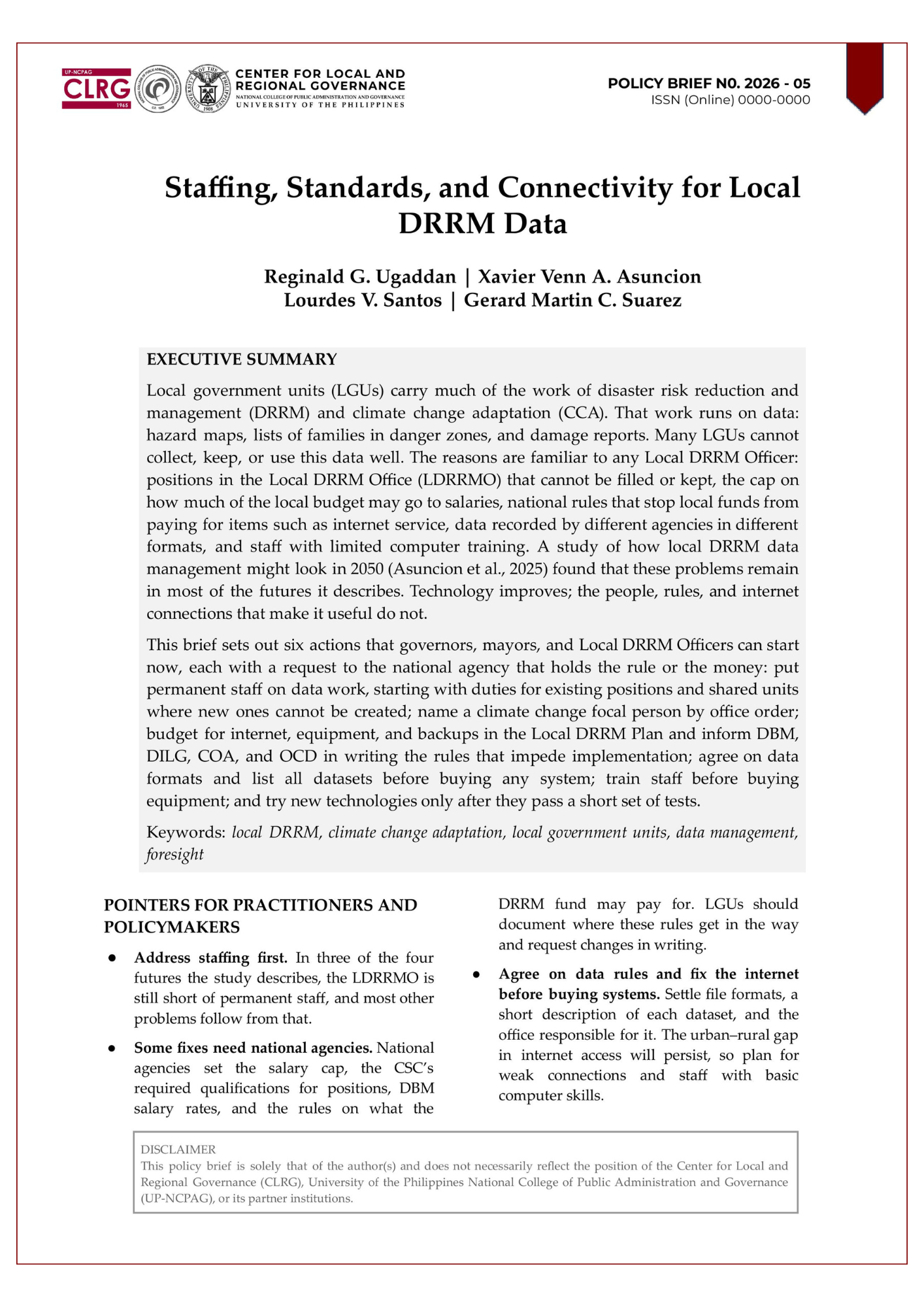
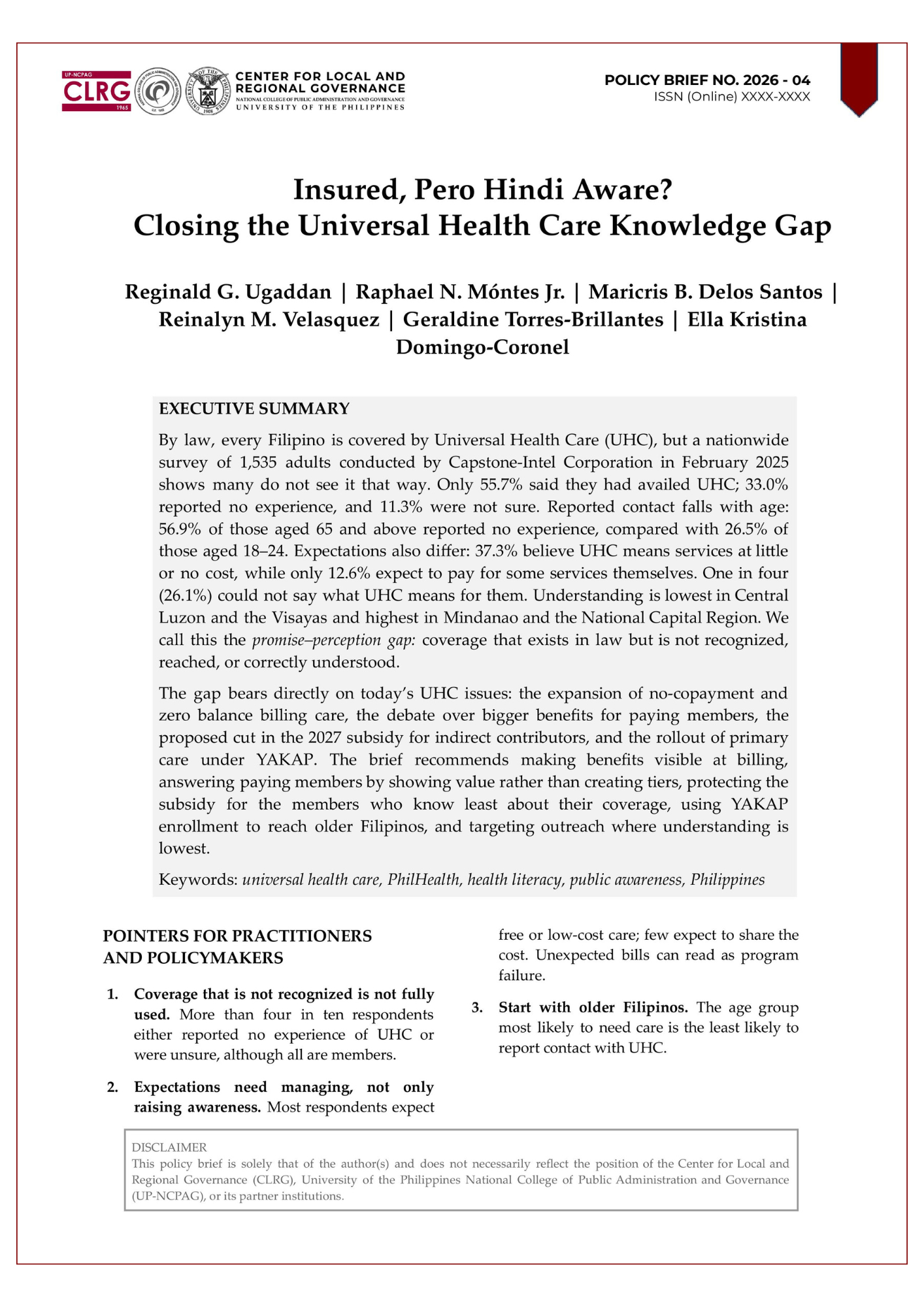
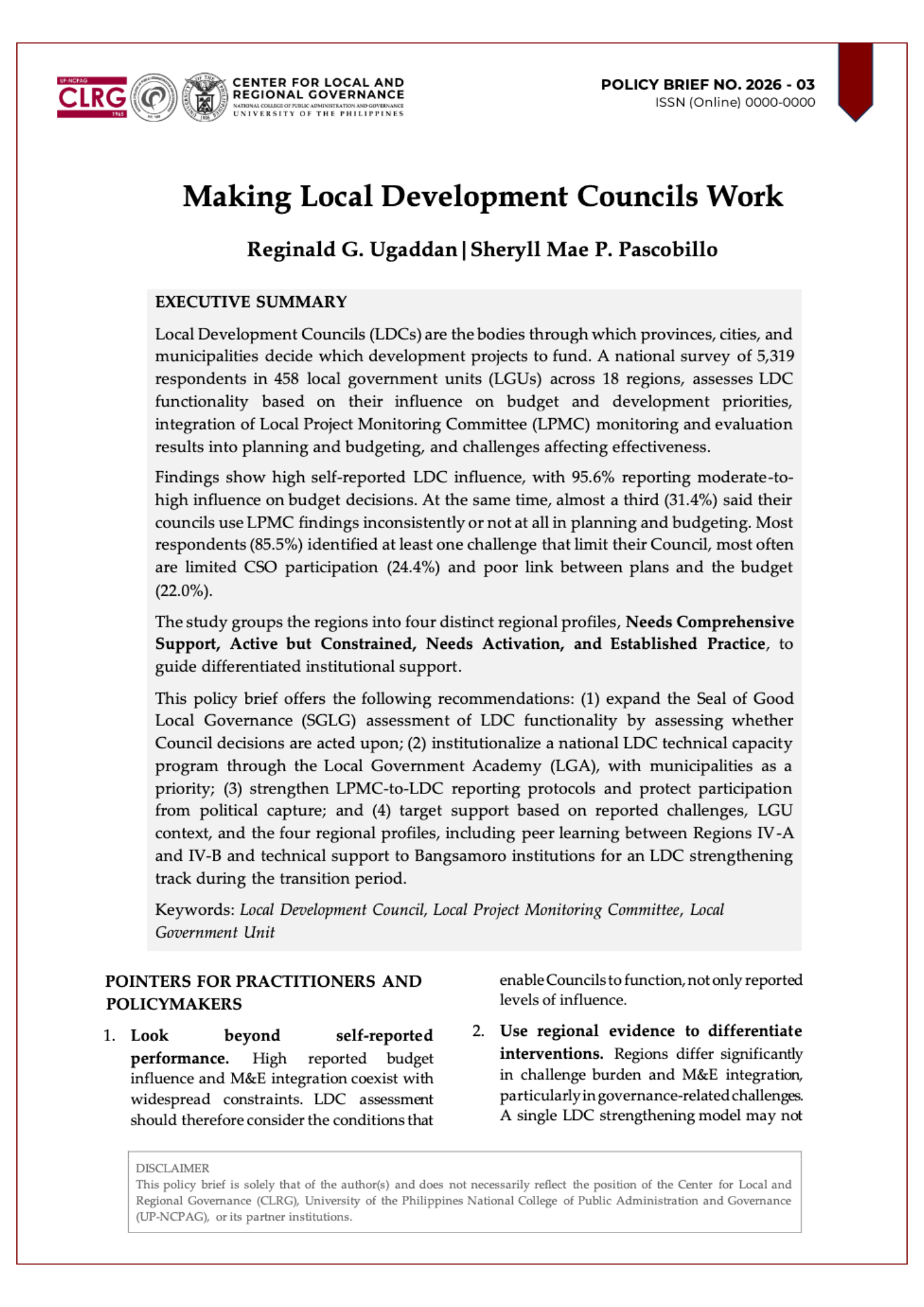
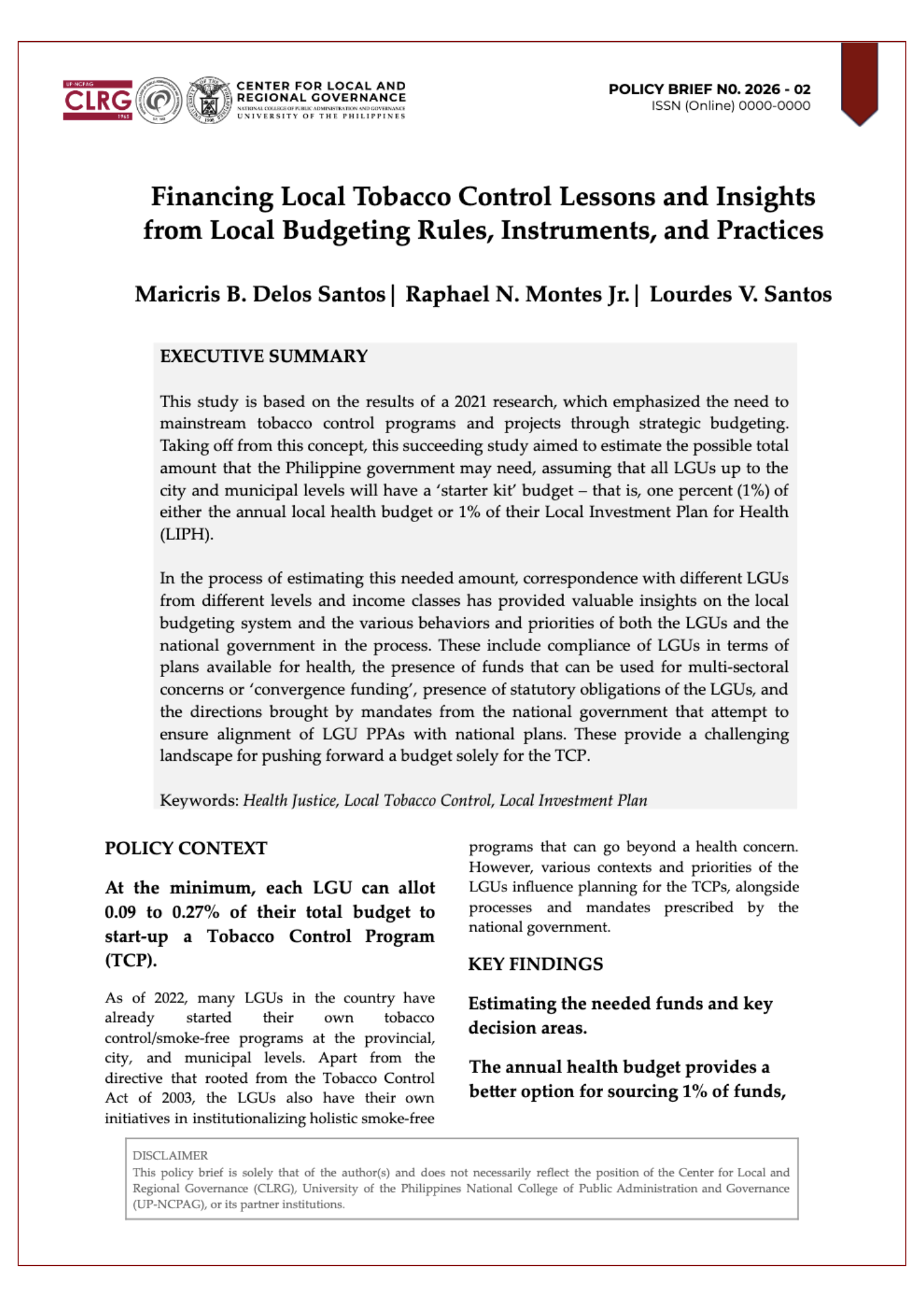
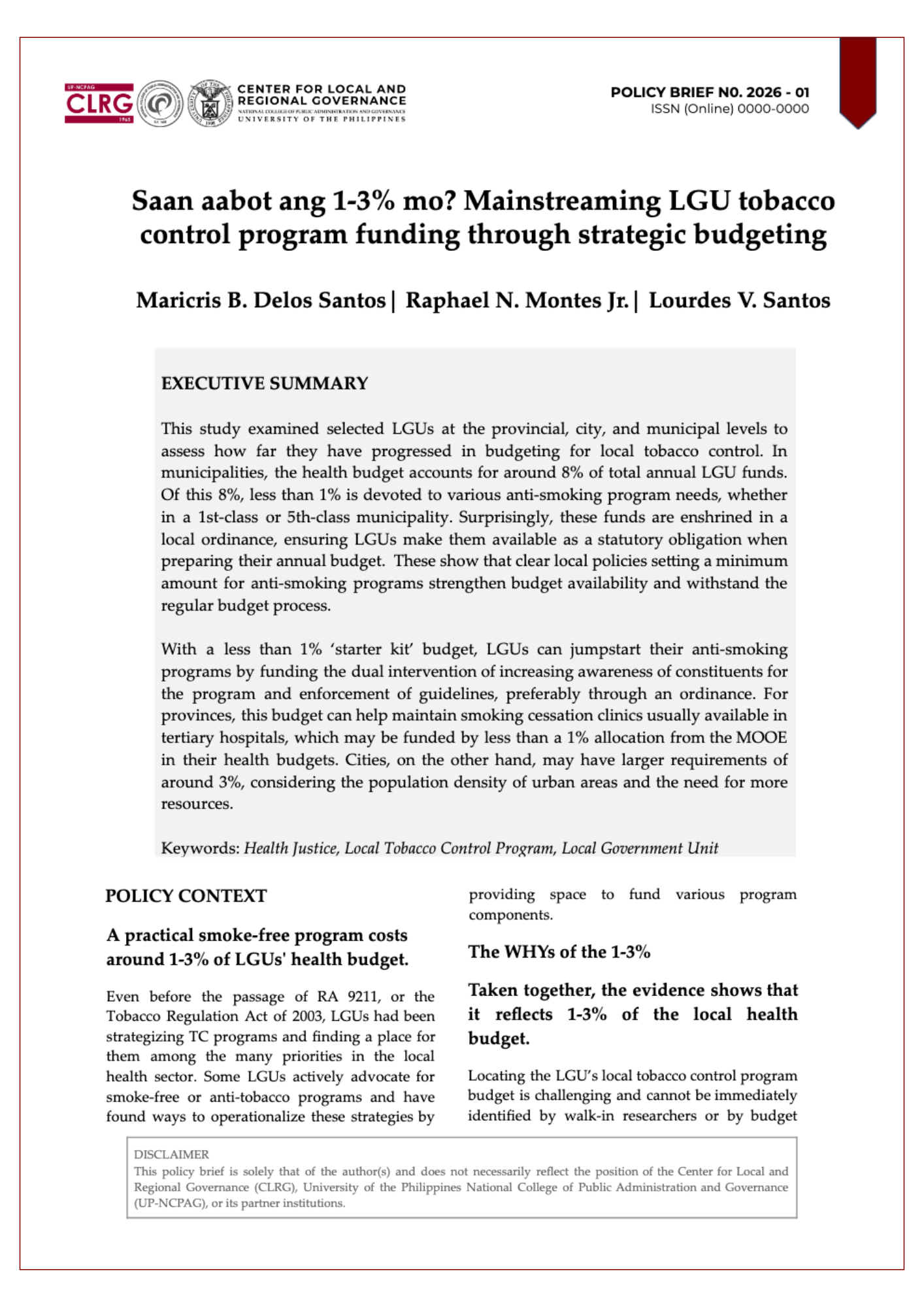
Latest policy briefs

Published by:
Center for Local and Regional Governance (CLRG)
University of the Philippines National College of Public Administration and Governance (UP-NCPAG)
Contact Us
Address: International Center for Public Administration (ICPA), R.P. De Guzman Street (NCPAG Compound), University of the Philippines Diliman, 1101 Quezon City
Phone Number: 8981-8500 loc. 4161
Email Address: clrgpolicybrief.upd@up.edu.ph
Facebook Page: facebook.com/up.localgov
